Designing a Fraud-Resistant Refund Verification System for Food Delivery
Overview
The Mission: Scaling Trust in an AI Era
As AI image generation becomes more accessible, platforms like Zomato face a new threat: 'Perfect' fraudulent claims. My mission was to design an adaptive verification system that eliminates AI-generated fraud while protecting the experience for 99% of genuine customers.
The Problem: The 'Deepfake' Refund Crisis
Zomato CEO Deepinder Goyal recently identified a surge in fraudulent refund requests using AI-generated photos of contaminated food. The Impact: • Financial: Massive 'refund leakage' hitting the bottom line. • Ecosystem: Restaurant partners losing money on false claims. • Operational: Support teams overwhelmed by manual verification of high-quality fakes.
Role
- • Product Manager
Duration
1 week (Rapid Strategy)
Team Members
1. Defining the User: Behavioral Segmentation
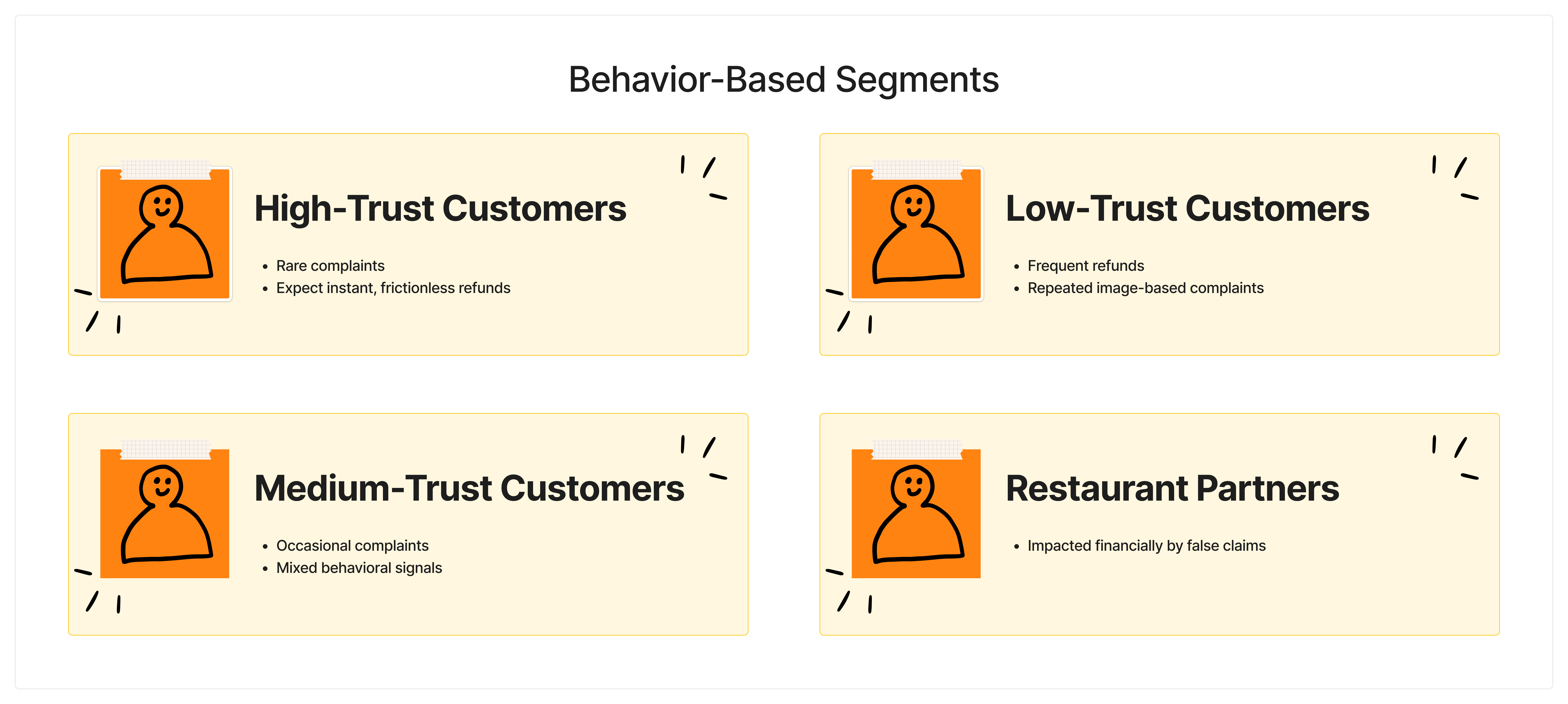
In a trust-based system, we cannot treat all users the same. I segmented our user base into three behavioral tiers based on historical data. This ensures that 'friction' is only applied where risk is highest.
2. Strategic Prioritization: Impact vs. Effort
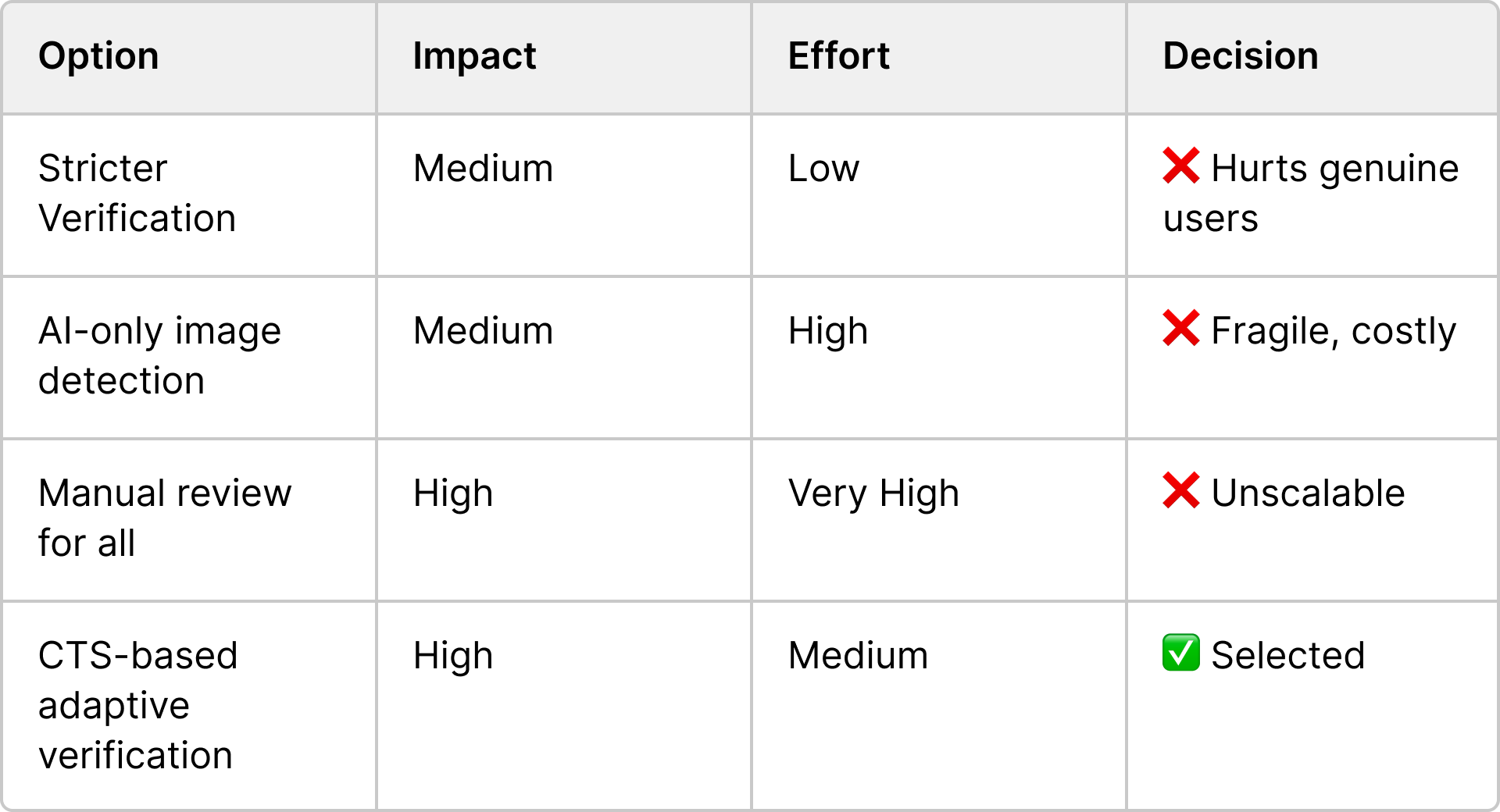
Solving fraud requires balancing technical complexity with immediate business value. I used an Impact vs. Effort matrix to decide which features would move the needle for the MVP. Key Decision: We prioritized Adaptive Verification because it provides high defense against AI with moderate engineering effort, compared to building a custom AI-detection model which is high-effort and prone to errors.
3. The 'Aha!' Insight: Action-Based Verification
Static images are easy to fake. Live actions are not. The core insight was to move from 'Proof of Condition' (showing the bad food) to 'Proof of Reality' (showing the user interacting with the food in real-time). By requiring randomized physical actions, we break the automation loop used by fraudsters.
4. The Solution: The CTS-Based Flow
The system runs a Customer Trust Score (CTS) evaluation the moment a complaint is filed: • Tier 1 (High Trust): User gets an instant refund. No photos required for low-value orders. • Tier 2 (New/Medium Trust): Standard photo upload with metadata (EXIF) check. • Tier 3 (High Risk): Mandatory Live Verification. The app disables the gallery and requires a 5-second video or live photo following a random prompt (e.g., 'Move your spoon through the food' or 'Show the restaurant bill next to the container').
5. Addressing Edge Cases & Trade-offs
What if a genuine user has bad lighting? The system allows 2 retries before escalating to a manual support agent. What about privacy? We only capture metadata relevant to the order (time/location) to ensure we aren't over-reaching on user data.
FRAUD RATE
Projected drop in fraudulent payouts by enforcing live verification on high-risk accounts.
PARTNER TRUST
Improved restaurant sentiment by reducing false quality claims.
FAST TRACK
Percentage of genuine users who still experience instant or near-instant resolution.
OPS COST
Significant reduction in manual ticket reviews for suspected fraud.
Future Roadmap & Expansion
1. Device Fingerprinting: Identifying 'Fraud Farms' using multiple accounts on one device. 2. AI-Forensics: Integrating server-side checks to detect GAN-generated patterns in uploaded media. 3. Incentivized Trust: Rewarding long-term 'Honest' behavior with Zomato Gold perks or faster support.
Conclusion
This project demonstrates that Product Management in Trust & Safety isn't just about 'blocking'—it's about designing intelligent friction. By using behavioral data and randomized physical prompts, we can outpace the evolution of AI-generated fraud while keeping the platform healthy for everyone.
Let's Connect
Open to discussions around product design, UX engineering, trust systems, and meaningful problem-solving.