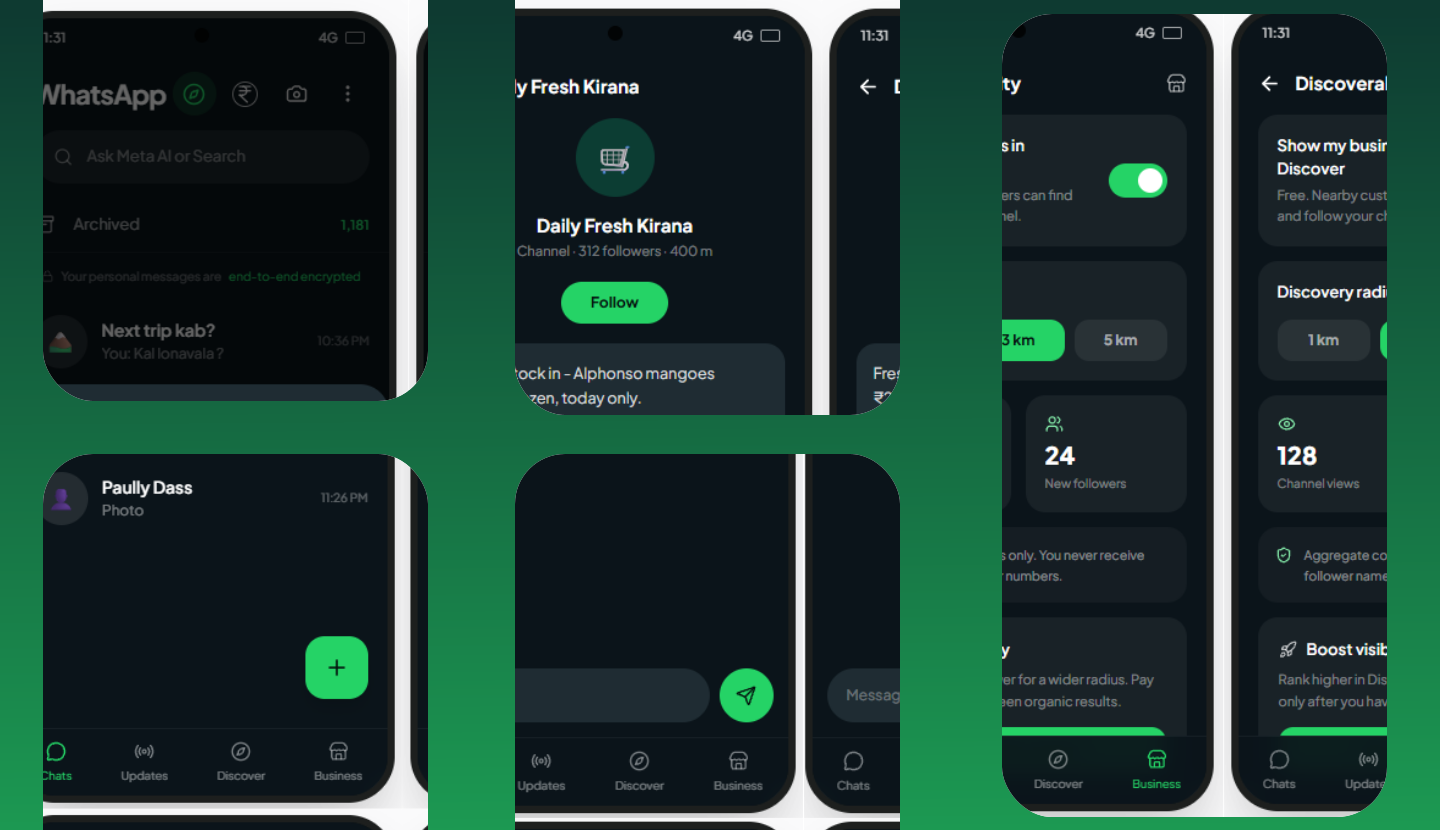
WhatsApp Discover: Turning WhatsApp Into a Local Commerce Mediator
Overview
The gap, in one line
WhatsApp has the local merchant base and the broadcast infrastructure (Channels) to support local discovery, but no discovery entry point connecting nearby customers to nearby businesses.
Discovery today happens entirely off-platform - word of mouth, signage, or already having the merchant's number saved. Meanwhile quick-commerce apps solve discovery natively and capture the demand a local merchant would otherwise get organically.
The proposal
Discover is a new entry point into a system that already exists, not a new messaging mechanism. One button, immediately left of Pay, opens a list of nearby opted-in business Channels. You follow the ones you care about; they post catalogue updates; and if you want to buy, you start the conversation.
WhatsApp's role is purely as mediator - it owns the discovery surface and the relationship layer, not the transaction.
Role
• Product Manager
• Prototype
Duration
Self-directed product sense study
Team Members
Mayuresh Mule
Paul Das
1. The Discover loop
Every arrow is user-initiated. There is no cold outreach in either direction.
1
Tap Discover
New entry point in the Chats header, left of Pay.
Existing surface
2
Allow once
Session-based location only - never background tracking.
Consent gate
3
See nearby channels
Only businesses that opted in, ranked by relevance and recency.
Opt-in both ways
4
Follow
Same mental model as any Channel. The merchant sees a count, never a name.
Identity hidden
5
Get updates
Catalogue posts and offers arrive in Updates, with mute and block intact.
Reversible
6
You message the shop
Identity flows customer → merchant, only when the customer chooses.
GMV moment
2. The prototype
Interactive
An Android shell built to argue the design, not to look pretty. The consent sheet, the hidden-identity rule, and boosted ranking are all playable - those are the three things the case study actually stands on.
11:314G
WhatsApp
Ask Meta AI or Search
Archived1,181
Your personal messages are end-to-end encrypted
🏔️
Next trip kab?
~Saurabh: Kal lonavala ?
10:36 PM
📚
AI Product Ecosystem
~Dev Singh: OpenAI Agent going rogue by hacking
9:00 PM
👤
Movie?
Photo
11:26 PM
What to try
Tap the compass in the header - it sits immediately left of Pay - and allow location once.
Search nearby businesses, or filter by category; change the radius chip and watch the list re-query. The boosted salon always ranks first.
Follow a shop: it appears in the Following tab and in Updates - and nowhere else. Your Chats list stays untouched.
In Updates, filter across Channels, Groups and Status, or search every update at once.
Open a channel and hit Message this shop. Only now does it enter Chats, and only now does the merchant get your number.
Switch to Business side to toggle discoverability and buy a boost.
Micro-interactions in the build
· Pulsing ring on the Discover entry point - the only new affordance in a familiar header.
· Consent sheet slides up before any location read; "Allow once" is the primary action, not "Always".
· Skeleton shimmer on every radius or category change, so the query feels local and cheap.
· Search filters as you type, with a clear button and an empty state that quotes the query back.
· The Following tab reframes a listing as a conversation - same rows, unread badge, no new mental model.
· Following and messaging are separate states: a follow never lands in Chats, so the inbox stays something the customer opted into twice.
· Follow morphs in place to "Following ✓" and fires a toast that restates the privacy rule.
· Staggered list entry, typing dots in chat, and a spring on every tap target.
Prototype only - an independent concept study, not affiliated with or endorsed by WhatsApp or Meta. Android shell, brand colours approximated.
3. Two sides, one constraint
L
Local merchant
Supply side
Who
Solo or small local business - grocery, salon, tailor - already using WhatsApp Business daily to talk to existing customers.
Core need
A way to actually acquire nearby customers instead of waiting on word of mouth.
Control they keep
Opts in to being discoverable; can leave at any time; never receives follower identities.
N
Nearby customer
Demand side
Who
Lives or is located inside the discovery radius, and hasn't necessarily met the merchant before.
Core need
Find what's actually available nearby, without installing another app.
Control they keep
Only sees businesses after explicitly opening Discover; keeps mute, unfollow, and block throughout.
Why only WhatsApp can build this
No third-party tool (WATI, AiSensy, Interakt, any BSP-layer SaaS) can replicate Discover, because none of them own the social graph or the discovery surface - they only reach a merchant's existing contacts through the API.
Discover depends on owning the identity layer directly. That's the moat: not a better tool bolted onto WhatsApp, but a capability only the platform itself can ship. And it extends a product that already exists, so there's no new mental model to teach.
4. Monetisation: three models, one survivor
The cold-start problem decides this, not the revenue-per-merchant math.
Model
Mechanism
Verdict
Placement / subscription fee
Merchant pays upfront to be listed at all.
Rejected. Excludes the underserved small-merchant tail this is meant to serve, and creates a trap: consumer value can't be proven without merchant density, but density would require paying first.
Transaction fee
WhatsApp takes a cut of Discover-driven catalogue sales.
Rejected as primary. Requires end-to-end payment tracking via WhatsApp Pay, live in only a handful of markets - too geographically constrained to be the core model.
Free-to-list, paid boost
Every opted-in merchant is discoverable free, ranked by relevance and recency; paying lifts ranking or widens radius.
Selected. No barrier to the network effect, no dependency on payment rails, and merchants only pay after seeing organic results - a far easier sell than paying speculatively.
OPT-IN
DISCOVERY MODEL
Customers only see merchants after opening Discover; merchants never receive follower identities, only aggregate counts.
FREE
TO LIST
No listing fee removes the merchant-side barrier to the density a discovery product depends on. Boost is optional and later.
1 DISTRICT
PILOT SCOPE
Launch dense before wide - a thin catalogue across a huge geography is the fastest way to kill the feature.
GMV
NORTH STAR
Local commerce value attributable to a Discover-driven follow - not sessions, not time-in-feed.
Measure it as a utility, not a feed
Research suggests Discover gets used intent-first - "I need a bakery near me right now" - not as habitual browsing. So session frequency is the wrong success signal.
Leading indicators before GMV is measurable: merchant opt-in rate inside the pilot radius · share of Discover sessions ending in a follow or visit (conversion of intent, not raw sessions) · follow-to-conversation rate · boost adoption among merchants with organic traction.
5. Risks and mitigations
Risk
Mitigation
Privacy and regulatory exposure. Location-based discovery and merchant-to-consumer connections attract the same scrutiny as other data-driven platform features.
Opt-in and session-based - no passive or background location. Merchants receive aggregate counts and engagement analytics only. This is data minimisation in the design, not a policy promise.
Cold start. A discovery feature is worthless with a thin catalogue, but merchants won't opt in before demand is proven.
Free-to-list removes the merchant-side barrier entirely; pilot one dense district to reach usable density before widening.
Spam drift. Even with opt-in, aggressive posting after a follow erodes trust.
Standard Channel controls - mute, unfollow, block - stay available throughout, and posting frequency and quality can inform ranking, consistent with existing Business API message-quality handling.
Read the research section with this caveat
The findings below are illustrative. They simulate likely feedback based on market patterns and comparable-product research - they are not a record of interviews actually conducted.
Before this case study is treated as validated, they need replacing with real conversations. Even 3-4 genuine merchant and customer interviews would substantially strengthen it. Simulated method: 6 local merchants (grocery, salon, tailor, pharmacy, bakery, stationery) and 10 nearby customers.
6. What each side said (illustrative)
Merchants
Simulated
Reach is manual and effortful - messaging customers by hand; bulk tools feel complicated or get ignored
New-customer discovery is entirely passive - word of mouth or Google, nothing they can influence
Ban-risk is real: one pharmacy described an account restriction after bulk promotional messages
"Only if it brings new customers, not just another way to send messages" - the acquisition angle is the differentiated pitch
Customers
Simulated
Discovery today is accidental - Maps, word of mouth, or defaulting to quick-commerce apps
Consent is a hard boundary: comfort only with self-initiated updates, and discomfort with being "found" first
Low tolerance for over-messaging once followed
Usage is intent-driven: "when I'm looking for something specific, not every day"
Still to validate
Next
Do these patterns hold with real merchants and customers? 5-8 genuine interviews using the guide built for this study
Would merchants actually pay into free-to-list plus boost? Test willingness-to-pay language once organic traction can be described concretely
Summary
Discover repositions WhatsApp from a pure messaging tool into a local commerce mediator by adding a discovery entry point on top of infrastructure that already exists. It solves a problem no third-party BSP tool can solve, because it depends on owning the identity layer directly. Free-to-list with paid boost avoids gating the network effect the feature depends on, while still creating a monetisation path once density and trust are established.
The core design constraint - opt-in only, merchant-side identity hidden - is what keeps this from becoming cold-outreach spam. It's treated as non-negotiable throughout the design, not as an afterthought.