Never hallucinate
If the answer isn't in the business's own content, the assistant says so and hands off to a human. A hard constraint, not a tunable.
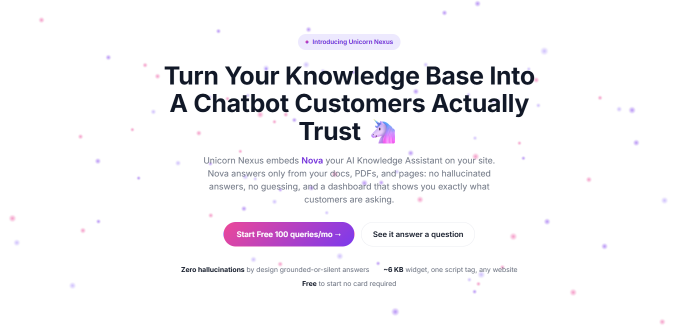
Most "AI chatbot for your website" products optimise for one thing: answering questions. I built Unicorn Nexus to answer a different one - what is your chatbot's inability to answer telling you about your business? Businesses upload their docs, embed an assistant ("Nova") on their site, and Nova answers strictly from what it was given, refusing to guess. That part is table stakes. The bet is the layer on top: a dashboard that mines every answered and unanswered question to show what's missing from the knowledge base - turning a support tool into a knowledge-improvement loop. Shipped solo across 8 phases. 53 logged decisions, 6 migrations, 2 production-shaped bugs caught by testing rather than by users, 1 credential incident handled correctly.
Hallucination is a liability. Generic LLM chatbots invent prices, policies and facts with total confidence. For a support widget, a hallucinated refund policy isn't a curiosity - it's a legal exposure. Silence is invisible. Even a well-behaved bot saying "I don't know" fails quietly. Nobody reads a raw query log, so the business never learns that 40 people asked about a shipping policy that doesn't exist in their docs yet.
8 phases - solo build, ongoing
Every unanswered question is a labelled data point about a content gap. Every answered question is a labelled data point about customer intent. So the chat log - the thing every competitor already has and ignores - is the asset. The product doesn't need a second data-collection surface; it needs to read the exhaust of the one it already has. Not "add more AI features," but "make the AI features the business already has legible and actionable."
Where the money is saved and where the intelligence layer gets its data - in one pass, at answer time.
Question arrives
From the embedded widget on the tenant's own site.
~6 KB widgetEmbed + vector search
Searches this tenant's chunks only - isolation enforced by Postgres RLS.
pgvectorSimilarity floor
An obvious miss skips the LLM call entirely and costs nothing but a vector search.
Cost capGrounded answer
Gemini Flash answers strictly from what was retrieved, or says it doesn't know.
Never guessesLogged + clustered
Every question is matched to a topic cluster in real time - no separate job.
One engineGaps + Intents
The dashboard reads those clusters into two views the owner can act on.
The productThese were written before the features, and they settled most arguments later.
If the answer isn't in the business's own content, the assistant says so and hands off to a human. A hard constraint, not a tunable.
Analytics, gap detection, clustering and drafting are all built by reading data the product already generates - no new instrumentation.
No feature assumes queues, cron, or vector index servers. Every phase works on Supabase and Vercel free tiers at real early-SaaS volumes.
A smaller feature with real data beats a bigger feature with placeholder data. This one cost four requested features.
From an empty repo to a configurable multi-tenant SaaS.
Supabase Auth plus Postgres Row Level Security so tenant isolation is a database guarantee, a workspace per signup, ingestion (paste / PDF / URL → chunk → embed → pgvector), and grounded retrieval with a similarity floor.
One script tag, ~6 KB, zero dependencies, Shadow-DOM isolated so it can't break or be broken by the host site's CSS. It derives its own API origin from its script src, so the same file works on every deployment.
Query volume, response time, grouped content gaps, and the headline "I don't know" rate - computed client-side, because at free-tier volumes a server-side aggregation job solves a problem that doesn't exist yet.
A rebrand plus a marketing page written for GEO as well as SEO - structured data and quotable FAQ content, on the thesis that answer engines are now a real discovery surface that rewards different content.
An 11-feature wishlist collapsed into one clustering engine and two dashboard views. Detailed below - it's the call I'd most want to be judged on.
Functional-but-generic dashboard to a premium responsive SaaS shell with three real breakpoints - done at the design-token and shell level, so ~15 pages inherited it for the cost of two files.
Renamed platform (Unicorn Nexus) and assistant (Nova) across every user-visible surface - while deliberately leaving the historical decision log unedited, old product name and all.
Company settings and an assistant personality engine built purely as prompt engineering on the existing model, with grounding enforced in the function signature. Settings propagate live to embedded widgets - no re-pasting the snippet.
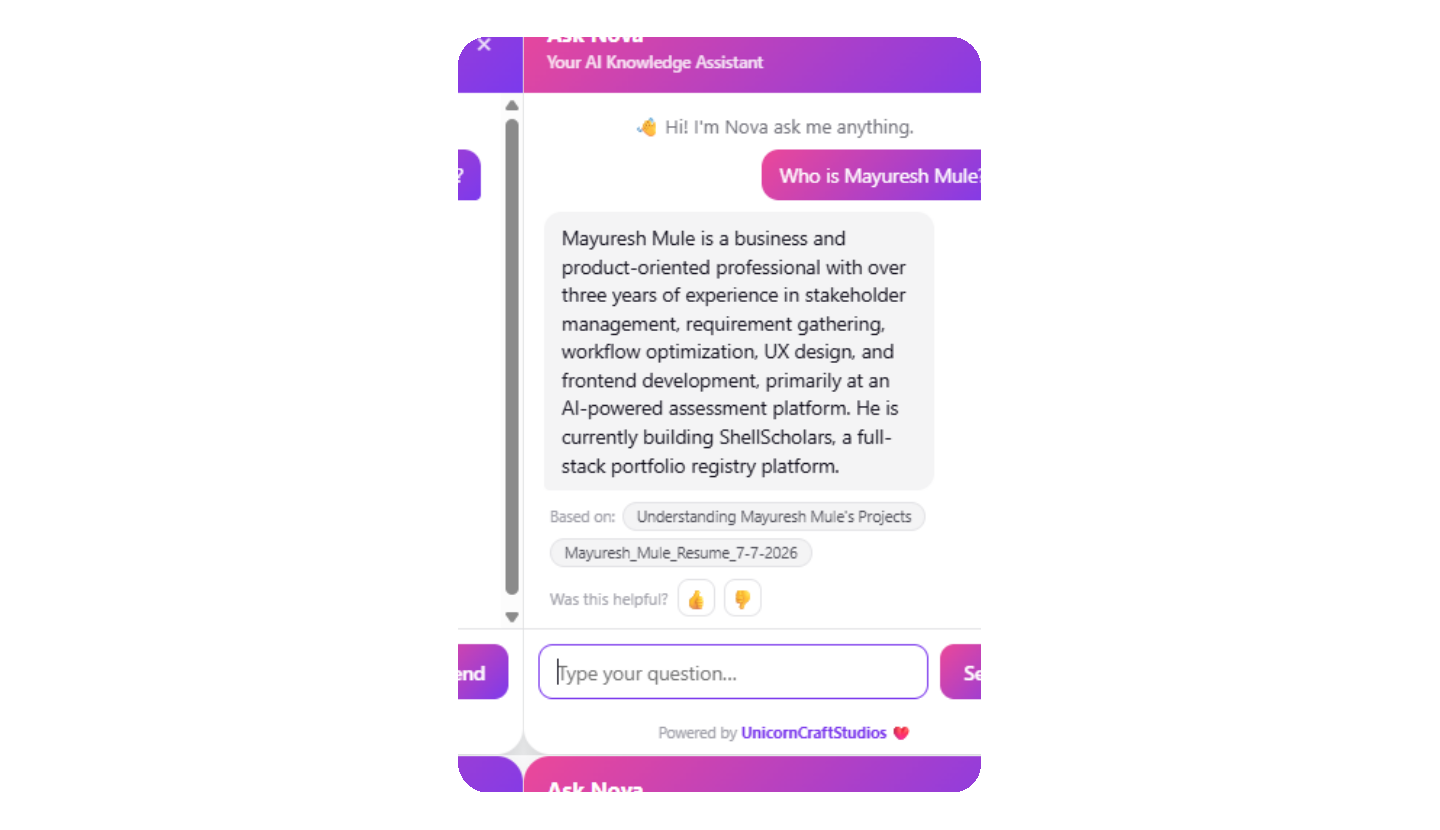
// The honest failure state is the feature: 'I don't know' plus a human handoff, logged as a gap.
I was handed an 11-feature wishlist and instructions to build "an AI Knowledge Intelligence Platform." Building all eleven would have produced eleven shallow, overlapping systems - several of which need real usage volume or infrastructure that doesn't exist yet, and would have had to be populated with fabricated numbers.
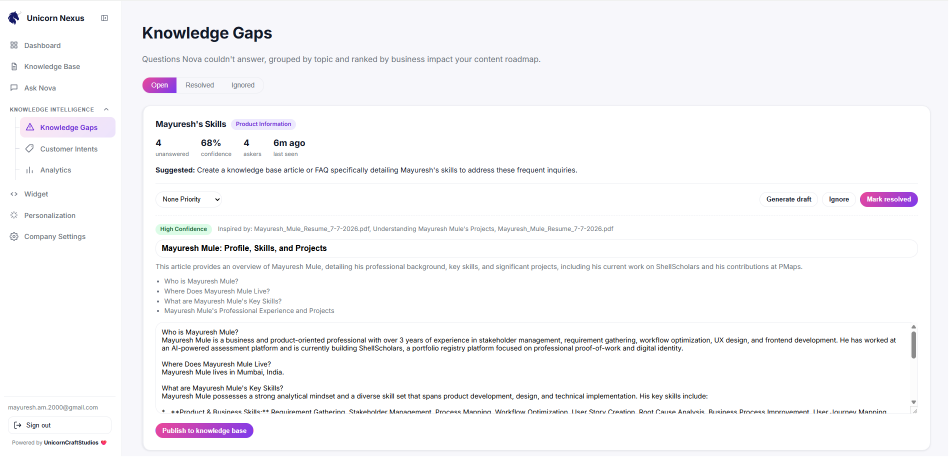
// Ranked by a formula the owner can read - unanswered volume × priority × recency decay, not a black box.
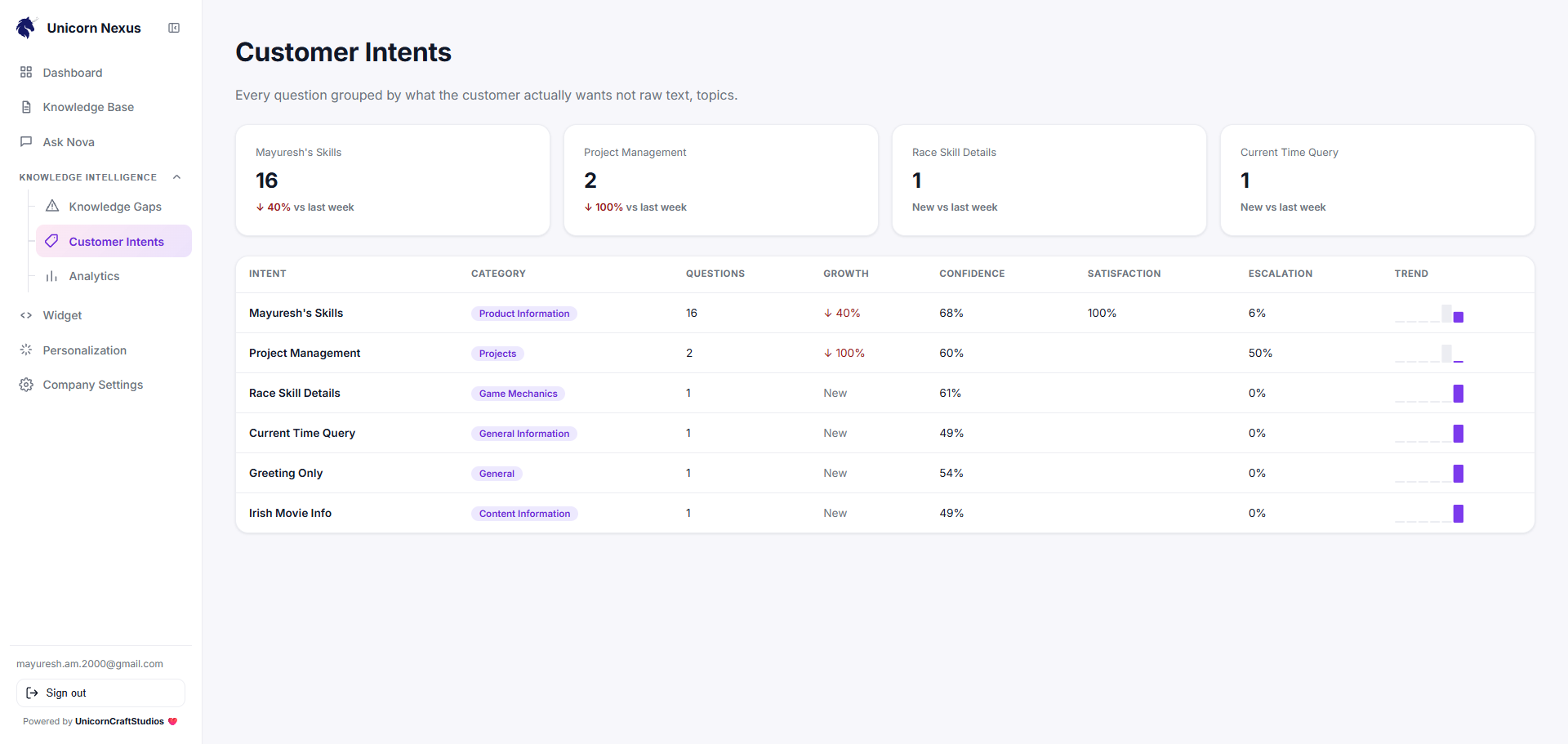
// High volume plus low satisfaction is the real prioritisation signal for what to document next.
LOGGED DECISIONS
Dated, numbered product and architecture decisions, each with its trade-off, written contemporaneously.
SHIPPED PHASES
Auth and multi-tenancy through to per-tenant personalisation - solo, from an empty repo.
SCOPE CALL
An 11-feature wishlist collapsed into one engine and two views; four features deferred with reasons.
EMBED WIDGET
One script tag, zero dependencies, Shadow-DOM isolated, self-configuring from its own src.
Seven calls, each with what it cost.
More upfront schema design on every table.
Tenant leakage is a security bug, not a UX bug - worth paying for with the database engine's guarantees rather than developer discipline.
A few borderline "maybe answerable" questions get the fallback.
It caps cost on the highest-volume failure mode - obviously out-of-scope questions - for near-zero UX cost.
Much less breadth against the requested list.
It avoided shipping fabricated data on features that need real volume first. The highest-leverage call in the project.
Labels can lag a fast-growing cluster briefly.
LLM spend stays proportional to signal rather than to raw traffic - the difference between a viable and a doomed free tier.
A more rigid function signature.
It makes an ungrounded personalised answer structurally impossible instead of a policy someone has to remember.
One extra request per widget load.
The literal difference between "settings changes need re-integration" and "settings changes just work" - a retention detail disguised as a technical one.
The log carries an inconsistent product name across its own history.
An accurate build history is worth more than a cosmetically consistent one - the same discipline a real postmortem needs.
A portfolio that only shows things going right isn't credible. Three incidents, and what each fix actually was.
| Incident | Why it was dangerous | The response |
|---|---|---|
| Silent tracking failure | A migration wasn't applied in one environment, so every chat quietly failed to log. Nothing crashed; the bot worked perfectly while Analytics, Gaps and Intents stayed empty. | Made the failure loud: server-side logging, a tracked flag on the API response, and a /api/diagnostics health check with a dashboard banner. The fix is a monitoring feature, not a patch. |
| CORS bug that only fails in production | A public endpoint allowed only POST, left over from before any GET endpoint existed. It passed every same-origin local test and would have broken the next real cross-origin request. | Caught by testing the actual cross-origin path. "It works when I test it" and "it works" are different claims. |
Committed .env with live keys | A service-role key that bypasses all row-level security, plus an LLM key, sitting in git history. | Flagged immediately rather than quietly fixed, blast radius explained (full data access), key rotation recommended as the only real remedy, and shared git history left for the repo owner to decide on. |
No live production traffic yet, so instead of invented usage numbers: here's what is already instrumented and how each signal should be read once it has users.
| Signal | How to read it |
|---|---|
| "I don't know" rate | The headline quality metric. Trending down means the knowledge base is closing real gaps, not just growing. |
| Gaps resolved vs ignored | Whether the gap loop drives content work, or just generates a report nobody acts on. |
| Cluster growth × satisfaction | Topics that are both high-volume and poorly served - the actual prioritisation signal. |
tracked: true rate | An internal health metric born from the silent-tracking incident. If it regresses, every metric above becomes unreliable, so it gates trusting the rest. |
Each phase waits on something specific. Nothing is built on top of a metric that doesn't exist yet.
A widget three-action UI (Chat / Callback / WhatsApp) plus a leads pipeline. Needs a real data model with a status workflow, not a settings tweak.
Per-workspace page with location-based greetings. Needs subdomain routing and a geo-IP provider decision not yet made.
Sequenced after the visual identity, so it's written once against the final brand instead of twice.
Duplicates, contradictions, graph - the Phase 7 cuts, now waiting on enough real content volume to make the signal meaningful instead of fabricated.
Each depends on an earlier phase's real data existing first.
Instrument for the intelligence layer from day one. The clustering engine retrofits meaning onto a query log that Phase 3 wasn't designed to feed it. It worked because the schema was additive-friendly, but designing the log with clustering in mind would have saved a migration. Write the "what we're explicitly not building and why" doc earlier. Collapsing the wishlist was right, but it happened reactively, mid-phase. Doing that scoping exercise as the first step of any large request makes the trade-off visible to a stakeholder before work starts, not after.